On-prem vs cloud LLMs: how to choose for sensitive data
On-prem LLMs keep regulated data inside your walls with full control and provable residency. Cloud LLM APIs win on speed and cost for non-sensitive work. Here is how to choose.
Choosing between an on-premise (self-hosted) LLM and a cloud LLM API comes down to one question: can the data safely leave your walls? For regulated or confidential data, an on-premise LLM is usually the right call, because it keeps every prompt, document, and answer inside your own infrastructure, gives you control over data residency, and produces audit trails you fully own. For non-sensitive work, a cloud LLM API is often the better choice: faster to start, no hardware to buy, and elastic scale. This guide compares on-prem and cloud LLMs on control, data residency, latency, cost shape, maintenance, and compliance, gives a break-even formula for the cost crossover, maps the usual answer by industry, and shows where a hybrid mix fits.
What is the difference between an on-prem LLM and a cloud LLM?
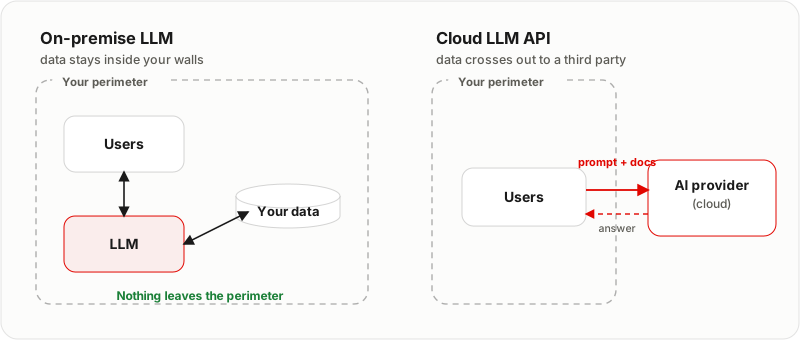
An on-premise (self-hosted) LLM runs inside infrastructure you control: your data center, a private cloud tenant, or an air-gapped network with no outbound connectivity. With an on-premise LLM, the model weights, the inference, and the data all stay within your perimeter. A cloud LLM API is a model hosted by a third-party provider that you call over the internet, so your prompts and any attached documents are sent to that provider for processing.
The core distinction between an on-prem LLM and a cloud LLM is the path your data takes. With an on-prem LLM, sensitive data never crosses your network boundary. With a cloud LLM API, it does, and you are trusting the provider’s contracts, controls, and jurisdiction to handle it.
On-prem vs cloud LLM: a side-by-side comparison
The table below compares an on-premise (self-hosted) LLM against a cloud LLM API across the dimensions that decide most sensitive-data deployments.
| Dimension | On-premise / self-hosted LLM | Cloud LLM API |
|---|---|---|
| Data control | Data never leaves your perimeter | Prompts and documents sent to a third party |
| Data residency | Fully determined by you | Determined by provider regions and contracts |
| Latency | Predictable, no internet round-trip; depends on your hardware | Variable; subject to network and provider load |
| Cost shape | Capex-heavy (GPUs, infrastructure) plus fixed run cost | Opex; pay per token, scales with usage |
| Maintenance | You own updates, scaling, and monitoring | Provider handles infrastructure and model updates |
| Scaling | Bounded by your hardware; plan capacity ahead | Elastic, near-instant |
| Compliance fit | Strong for regulated, residency-bound data | Strong for non-sensitive workloads |
| Time to start | Slower; provisioning and setup | Minutes |
Should we self-host an LLM, or is a cloud API fine?
Self-host an LLM when the data is regulated, confidential, or bound by residency rules. Use a cloud LLM API when the data is public or low-risk and speed of setup matters more than control.
A cloud LLM API is genuinely fine, and often better, for a large class of work:
- Drafting public-facing marketing copy or documentation
- Internal brainstorming over non-confidential material
- Prototyping before you commit to an architecture
- Bursty, unpredictable workloads where elastic scale saves money
An on-premise LLM becomes the right call when:
- The data is subject to banking, healthcare, or government regulation
- Data residency or sovereignty is a contractual or legal requirement
- An air-gapped network is mandated
- You need full ownership of audit logs for examiners or auditors
A useful test: if a single prompt accidentally containing a customer record, a patient file, or classified material would trigger a breach notification, that workload should not run through a cloud LLM API.
How do data residency and compliance differ between on-prem and cloud LLMs?
With an on-premise or air-gapped LLM, data residency is something you decide and can prove, because the data physically stays in infrastructure you operate. There is no outbound call to inspect, no provider region to reconcile, and no cross-border transfer to justify. For regulated institutions, an on-premise LLM turns a policy promise into a verifiable architecture.
With a cloud LLM API, residency and compliance depend on the provider’s regions, sub-processors, retention settings, and contractual terms. That can be acceptable, but it shifts the burden to continuous vendor assurance rather than a fixed boundary. This architecture-over-policy distinction is the heart of why your AI shouldn’t leave your walls, and it is why the Teclops AI security approach treats the deployment boundary as the first control, not the last.
What does an on-prem LLM cost, and what about latency?
An on-premise LLM is capex-heavy: you provision GPUs and infrastructure up front, then run at a relatively fixed cost regardless of how many queries you serve. A cloud LLM API is opex: you pay per token, so cost tracks usage and starts near zero. For steady, high-volume internal use, owned hardware can be cheaper over time; for spiky or experimental use, paying per token avoids stranded capacity. For the full cost breakdown and the three drivers that move the crossover point, see on-prem LLM TCO: when GPUs beat cloud APIs.
On latency, an on-premise LLM removes the internet round-trip and gives you predictable response times, bounded only by your own hardware. Cloud LLM latency is usually low but varies with network conditions and provider load. Air-gapped deployments also keep working when external connectivity is down, which matters for critical internal systems.
When does an on-prem LLM beat a cloud API? A break-even formula
An on-premise LLM beats a cloud API on cost when your steady monthly token volume is high enough that the fixed cost of owned hardware, spread across those tokens, falls below the per-token API bill. You can estimate the crossover with one formula. Define:
- C = capital cost of the GPU node (GPU, server, memory, storage)
- L = amortization period in months (36 is a common three-year service life)
- W = monthly power and cooling cost (average kW draw x hours run x electricity rate x cooling overhead)
- O = monthly operations share (the slice of engineering time that keeps the stack patched and monitored)
- P = blended cloud API price per million tokens for a model good enough for the task
- T = your monthly token volume, in millions of tokens
Monthly on-prem cost is C / L + W + O. Monthly cloud cost is T x P. On-prem wins on cost when:
T > (C / L + W + O) / P
A worked example, using anchors you should replace with your own quotes. As of mid-2026, a top-end 80 GB data-center GPU carries a street price of roughly $25,000 to $40,000 depending on variant and channel. Take C = $40,000 for the GPU plus the server around it, and L = 36 months, giving about $1,100 per month of amortized capex. Suppose your power, cooling, and ops share add another $1,900 (substitute your real rates), for a fixed monthly cost near $3,000. As of mid-2026, cloud API list prices span roughly $0.10 to $30 per million tokens depending on model tier and input versus output split, so pick the blended price of the model you would actually use; at an illustrative P of $3 per million tokens, break-even is T = 3,000 / 3 = 1,000 million tokens per month, on the order of tens of millions of tokens every day.
Two honest adjustments before you trust the result. First, recompute the on-prem side at realistic utilization, not the theoretical peak: a node running at a quarter of capacity has roughly four times the effective cost per token you first assumed. Second, there is a middle option, renting a dedicated cloud GPU, which as of mid-2026 runs roughly $2 to $13 per GPU-hour depending on provider class; it keeps the fixed-cost shape without the capex, though your data still leaves your walls. For the full cost model and the three drivers that move the crossover, see on-prem LLM TCO: when GPUs beat cloud APIs.
Which deployment fits your industry? A decision matrix
Regulation, not preference, usually decides the deployment mode. The matrix below maps the most common regulated sectors to their typical data class, the driver that dominates the decision, and the usual answer.
| Sector | Typical data class | Typical driver | Usual answer |
|---|---|---|---|
| Bank | Customer financial records, KYC files | Banking regulation, examiner-ready audit trails | On-prem or air-gapped (banks deep dive) |
| Hospital | Patient records, clinical notes | Health-data privacy law, breach-notification liability | On-prem or air-gapped (hospitals deep dive) |
| Law firm | Privileged client documents, case files | Attorney-client privilege, confidentiality duties | On-prem or air-gapped (law firms deep dive) |
| Government agency | Citizen data, classified material | Sovereignty mandates, air-gap requirements | Air-gapped, sovereign (government deep dive) |
The pattern across all four rows: the more a sector’s data carries legal duties (privilege, privacy law, sovereignty), the more the answer shifts from cloud toward on-prem and then fully air-gapped. Non-sensitive work inside these same institutions can still use a cloud API, which is exactly why most of them end up with a hybrid setup.
What does a hybrid LLM deployment look like?
A hybrid LLM deployment runs sensitive workloads on-premise and non-sensitive workloads through a cloud API, routed by data classification rather than convenience. In practice, most organizations that adopt on-prem AI do not abandon the cloud entirely; they keep a cloud lane for the work that never touches regulated data and reserve owned hardware for the work that does.
Workloads that belong on the private side:
- Retrieval and question answering over internal, regulated, or privileged documents
- Anything that touches customer records, patient data, case files, or classified material
- Workloads where you must own the audit log end to end
- Systems that must keep working when external connectivity is down
Workloads that can stay on the cloud side:
- Public-facing copy, documentation drafts, and translation of non-confidential text
- Brainstorming and prototyping on synthetic or public data
- Bursty, experimental jobs where elastic per-token pricing beats owned capacity
The economics reinforce the split: steady, high-volume sensitive workloads are exactly the ones that clear the break-even formula above, while spiky experimental work is exactly what per-token pricing is good at. The one non-negotiable is governance: the routing rule must key off data classification, enforced at the gateway, so a sensitive prompt can never drift down the cloud path by accident. Samvad AI supports this directly, because its deployment mode (on-premise, air-gapped, or hybrid) is switchable by configuration, so the boundary is set by policy you control rather than by whichever tool a team happened to open.
How does Samvad AI apply the on-prem case?
Samvad AI is built for the on-premise case from the ground up. Samvad AI is a secure, source-cited RAG assistant that answers only from your own documents and deploys on-premise, air-gapped, or hybrid, switchable by configuration. That means the same assistant can run entirely inside a bank’s data center, on an air-gapped government network, or in a hybrid setup, without sending your documents to an outside provider.
Beyond the deployment boundary, Samvad AI is designed for the controls regulated institutions actually need:
- Samvad AI cites the exact source passage for every answer and says plainly when an answer is not in your sources.
- It is permission-aware at the role and row level, so users only see what they are cleared to see.
- It keeps a tamper-evident audit log for examiners and auditors.
- It is multilingual (English, Hindi, and more), for banks, hospitals, universities, enterprises, and governments.
This is the on-prem argument made concrete: control, residency, and verifiable audit trails delivered as architecture rather than as a vendor promise.
The bottom line: which LLM deployment fits sensitive data?
Use a cloud LLM API for non-sensitive, public, or low-risk work where speed and elastic scale win. Choose an on-premise or air-gapped LLM when the data is regulated, confidential, or residency-bound, and you need to prove (not just assert) that it never left your control. If your use case sits in the second category, Samvad AI is built to run there. Reach the Teclops AI team at teclops.ai@gmail.com.
Frequently asked questions
Should we self-host an LLM or use a cloud API?
Self-host an LLM when the data is regulated, confidential, or subject to residency rules, because on-premise deployment keeps every prompt and document inside your own infrastructure. Use a cloud LLM API when the work is non-sensitive (public content, drafts, internal brainstorming) and speed of setup matters more than data control. The deciding question is whether sending the data to a third party is acceptable under your compliance obligations.
Is on-premise AI worth it for a regulated institution?
On-premise AI is worth it for banks, hospitals, universities, and governments because it guarantees data residency, removes third-party data exposure, and produces audit trails you fully own. The trade-off is higher upfront capex (GPUs, infrastructure) and in-house maintenance instead of a pay-as-you-go cloud bill. For institutions where a data leak or a compliance failure carries legal and reputational cost, that control is usually worth the operational overhead.
What is a private LLM for regulated data?
A private LLM for regulated data is a language model deployed inside your own infrastructure (on-premise, air-gapped, or hybrid) so that confidential documents and user prompts never leave your control. It typically pairs the model with retrieval over your own documents, role and row-level permissions, and a tamper-evident audit log. Samvad AI from Teclops AI is an example: a source-cited RAG assistant that answers only from your documents and can run fully air-gapped.
Can you run an LLM in your own data center?
Yes, you can run an LLM in your own data center using on-premise or air-gapped deployment, which keeps all inference and data inside your network with no outbound calls to a cloud provider. This requires GPU hardware, a serving stack, and operational ownership of updates and monitoring. Samvad AI is built to deploy on-premise, air-gapped, or hybrid, switchable by configuration, so the same assistant can run entirely within your data center.
When is a cloud LLM the right choice?
A cloud LLM API is the right choice for non-sensitive work where the data is public or low-risk, where you want to start in minutes without buying hardware, and where elastic scale matters. It shifts cost from capex to opex and offloads maintenance to the provider. The constraint is that your data leaves your walls, so cloud is a poor fit for regulated, confidential, or residency-bound workloads.
What is a hybrid LLM deployment?
A hybrid LLM deployment runs sensitive workloads on an on-premise model while routing non-sensitive workloads to a cloud LLM API, with the split decided by data classification rather than convenience. Regulated documents, customer or patient data, and audit-bound work stay inside your perimeter; public content drafting and experimentation can use the cloud. The routing rule must be enforced at the gateway so sensitive prompts can never drift to the cloud path, and Samvad AI supports this by making its deployment mode switchable by configuration.